£26bn
Estimated overdue payments outstanding
2025 research · UK businesses · at a given time
Payment backlog across businesses, not the value of debit notes or disputed invoices.
Office of the Small Business Commissioner, 31 July 2025 My Inventory Items
Debit note templates & practical guides
A seller debit note records an increase to an earlier invoice. Link each undercharge, omitted item or agreed addition to the original sale and show exactly what changes.
Downloadable PNGs · Worked examples · Official UK VAT sources
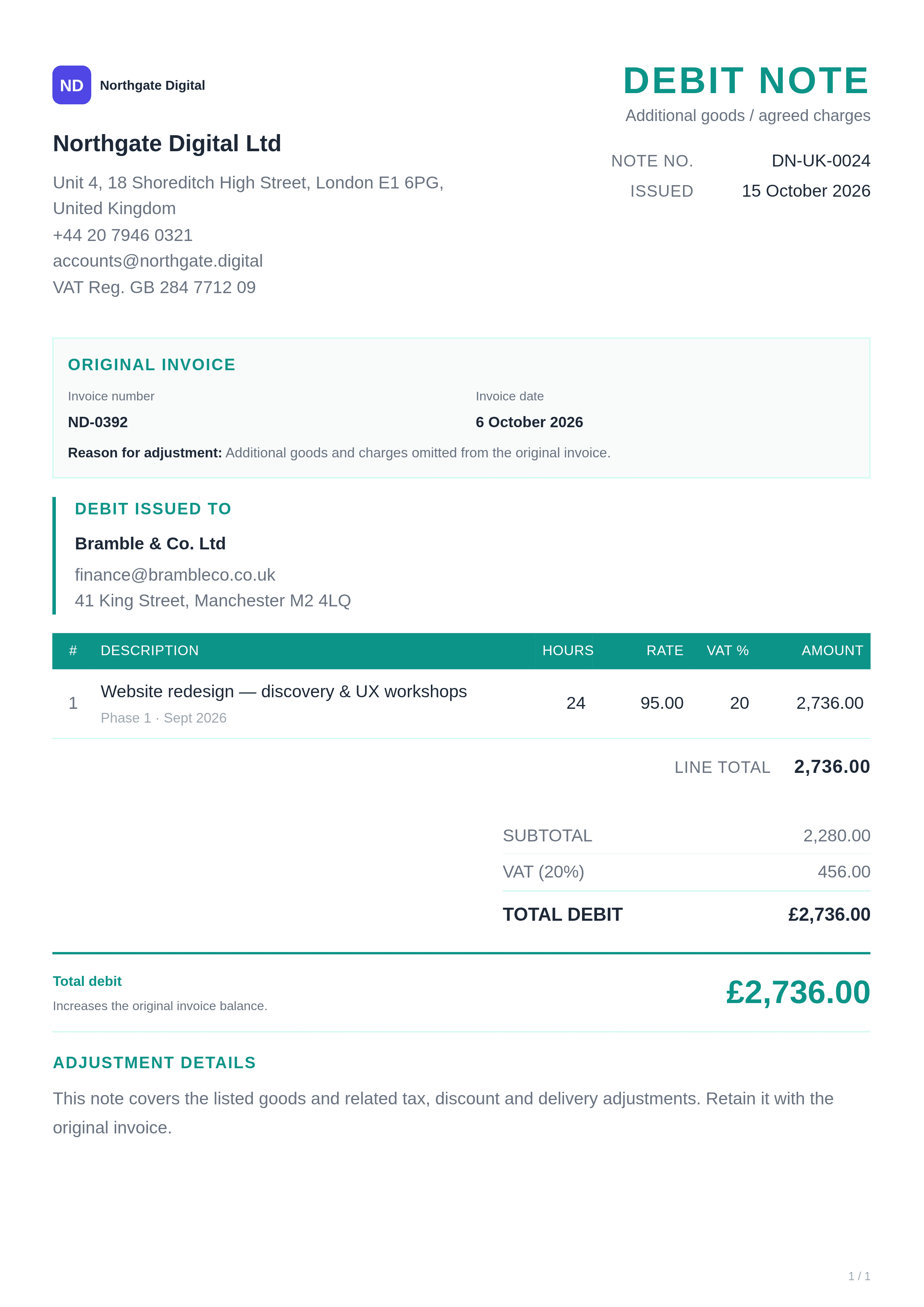
A seller debit note records an additional charge against an earlier invoice. A buyer debit memo can instead request supplier credit for a return or shortage. Identify who issued it and the intended effect on the balance before posting.
A seller debit records an additional charge. A buyer memo records a supplier claim. Payments and goods movements need their own evidence. Link them together so an adjustment cannot be counted twice.
Prepare a debit note with issuer details, original invoice references, approved additional charges, tax and a clear total.
Handle omitted goods, approved extra services and freight charges with evidence, invoice links and worked balance examples.
Track buyer debit memos as supplier claims, document shortages and reconcile accepted supplier credits without double counting.
See simplified seller debit and buyer claim examples, receivable and payable effects, and controls against duplicate accounting entries.
Understand supplier debit notes under CGST section 34, invoice undercharges, GST fields and supporting reconciliation records.
Published research · Context and scope
These studies explain the scale of returns and overdue payments. They do not count credit or debit notes, establish a global note issuance rate, or measure results from using this site. US retail and UK business findings describe different populations and should not be combined.
£26bn
2025 research · UK businesses · at a given time
Payment backlog across businesses, not the value of debit notes or disputed invoices.
Office of the Small Business Commissioner, 31 July 2025£17,000
2025 research · UK · affected businesses
An average for businesses affected by late payments, not for all businesses.
Office of the Small Business Commissioner, 31 July 202528%
2025 research · UK · over 1.5 million businesses
A broad payment performance measure; the study does not isolate adjustment documents.
Office of the Small Business Commissioner, 31 July 202586 hours
2025 research · UK · per affected business
Estimated collection workload. Clear references aid reconciliation; no time saving is claimed here.
Office of the Small Business Commissioner, 31 July 2025$849.9bn
2025 · US retail · NRF / Happy Returns projection
Estimated value of merchandise returns, not credit notes issued.
NRF 2025 Retail Returns Landscape15.8%
2025 · US retail · retailer estimate
Overall return rate reported by NRF; not an invoice correction rate.
NRF release, 15 October 202519.3%
2025 · US online retail · estimate
Online returns create reconciliation work across order, stock and payment records.
NRF 2025 Retail Returns Landscape9%
2025 · NRF / Happy Returns report
Supports checking return evidence; does not measure fraudulent credit notes.
NRF 2025 Retail Returns LandscapeResearch published in 2025; links checked 17 October 2026. NRF values are report estimates or projections. UK findings come from commissioned survey and economic analysis, rather than this website’s customer data.
Illustrative operational scenarios, not named customer case studies. GBP examples assume 20% tax for arithmetic only; apply the actual treatment of the supply.
Trigger: An approved project extension was omitted from the original bill.
Action: Link the approved extra work to the original invoice and charge only the omitted amount.
Evidence: Signed scope change, timesheet, rates and original invoice.
Original invoice £1,200.00 · Already paid £400.00
£1,160 remains due after the existing payment. Do not bill the original work twice.
Trigger: Five delivered units were omitted from the original invoice.
Action: Reconcile delivery quantity to billed quantity and document the agreed increase.
Evidence: Order, dispatch note, proof of delivery and original invoice.
Original invoice £900.00 · Already paid £0.00
£1,200 is now due. No second stock dispatch occurs merely because the bill is corrected.
Trigger: An agreed delivery charge was left out of a paid invoice.
Action: Verify the contract and applicable freight tax treatment before adding the omitted charge.
Evidence: Freight agreement, delivery evidence, carrier charge and invoice.
Original invoice £600.00 · Already paid £600.00
£96 remains due. The example assumes 20% tax; freight can require a different treatment.
Trigger: Buyer finds a shortage and sends a debit memo requesting supplier credit.
Action: Track the memo as a claim. Match any agreed supplier credit before settling the payable.
Evidence: Purchase order, goods receipt, supplier invoice and acceptance of claim.
Original invoice £600.00 · Already paid £0.00
£480 would remain payable after a £120 supplier credit is accepted and posted. A buyer claim alone is not that acceptance.
Step 1
Match the order, invoice number, customer or supplier, currency and affected lines. Keep the original invoice intact.
Step 2
Establish whether the issuer is a seller adding a charge or a buyer requesting supplier credit. Verify the contract and acceptance.
Step 3
Use a unique document number, issue date, reason, line amounts and relevant tax details. Share it with the counterparty and retain the approval.
Step 4
Link the adjustment to the invoice and customer or supplier account. Match payments, refunds and accepted claims without duplicate allocations.
Use these internal formulas to monitor your process. All example values below are hypothetical, with no industry target or promised improvement.
| Metric | Formula | Worked example | How to use it |
|---|---|---|---|
| Adjustment rate | Invoices with at least one adjustment ÷ invoices reviewed × 100 | 12 adjusted invoices ÷ 400 invoices = 3%. Count invoices once even if several notes exist. | Investigate causes by customer, product and reason; this is an internal measure, not a benchmark. |
| Credit value ratio | Net credits for an invoice cohort ÷ original net invoice value × 100 | £2,000 net credits ÷ £100,000 net original billing = 2%. Use a consistent cohort and currency. | Track value lost to returns, allowances or overbilling corrections without mixing tax into net sales. |
| Debit recovery ratio | Payments allocated to seller debit notes ÷ gross debit value due × 100 | £900 received ÷ £1,200 due = 75%. Exclude future due dates and buyer claim memos. | Separate documented extra charges from cash actually collected. |
| Resolution time | Sum of days from claim logged to agreed outcome ÷ resolved claims | 40 total calendar days across 8 resolved claims = 5 days on average. | Track unresolved aging separately so open cases do not disappear from the picture. |
| Reference completeness | Notes with required invoice and evidence links ÷ notes reviewed × 100 | 48 fully linked notes ÷ 50 notes = 96%. Define the required evidence before reviewing. | Find missing invoice numbers, approvals and settlement records before posting. |
| Record | Issued by | Effect | Typical use |
|---|---|---|---|
| Seller credit note | Supplier / seller | Reduces the invoiced charge | Accepted return, allowance or overcharge correction |
| Seller debit note | Supplier / seller | Increases the invoiced charge | Underbilling or an agreed omitted charge |
| Buyer debit memo | Customer / buyer | Requests a supplier credit; track acceptance | Purchase shortage, damage or return claim |
| Refund record | Party returning money | Records cash returned | Payment reference settling a customer credit |
| Stock movement | Warehouse / inventory team | Records physical quantity and condition | Return receipt, quarantine or dispatch |
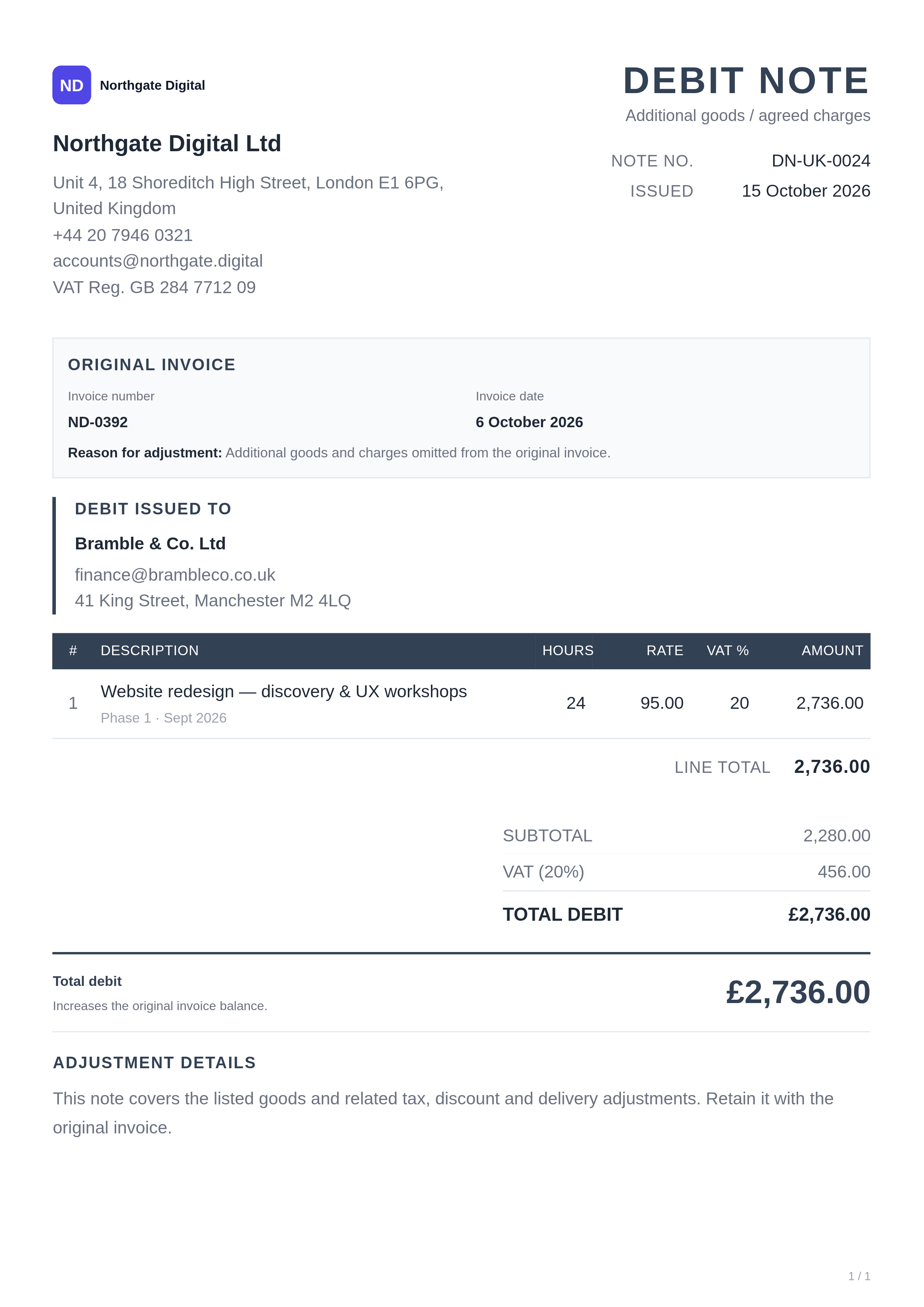
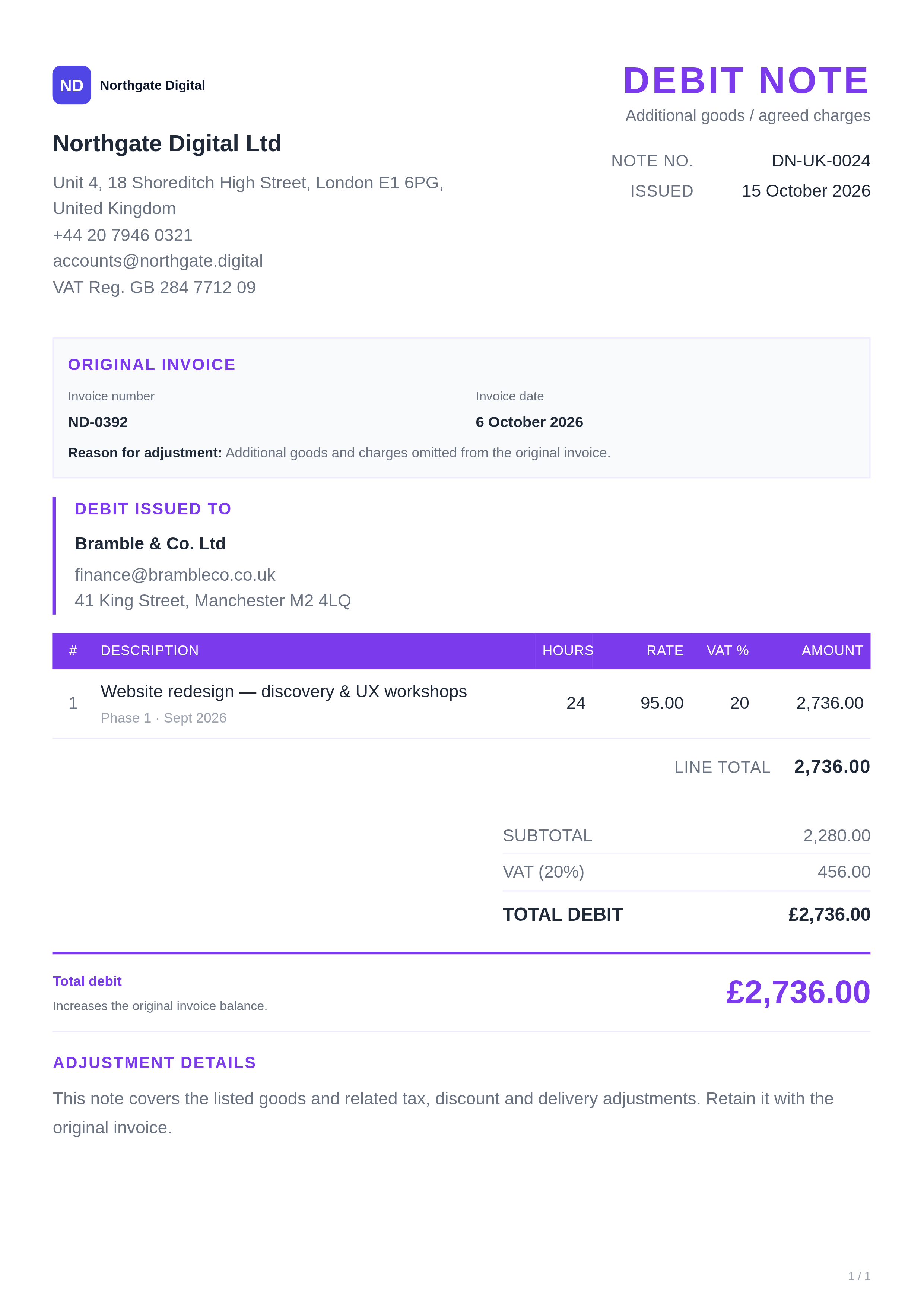
Download static PNG design previews containing sample business details. The supplied UK layout is available in ten accent colors. These are reference images, not editable forms or completed business documents.
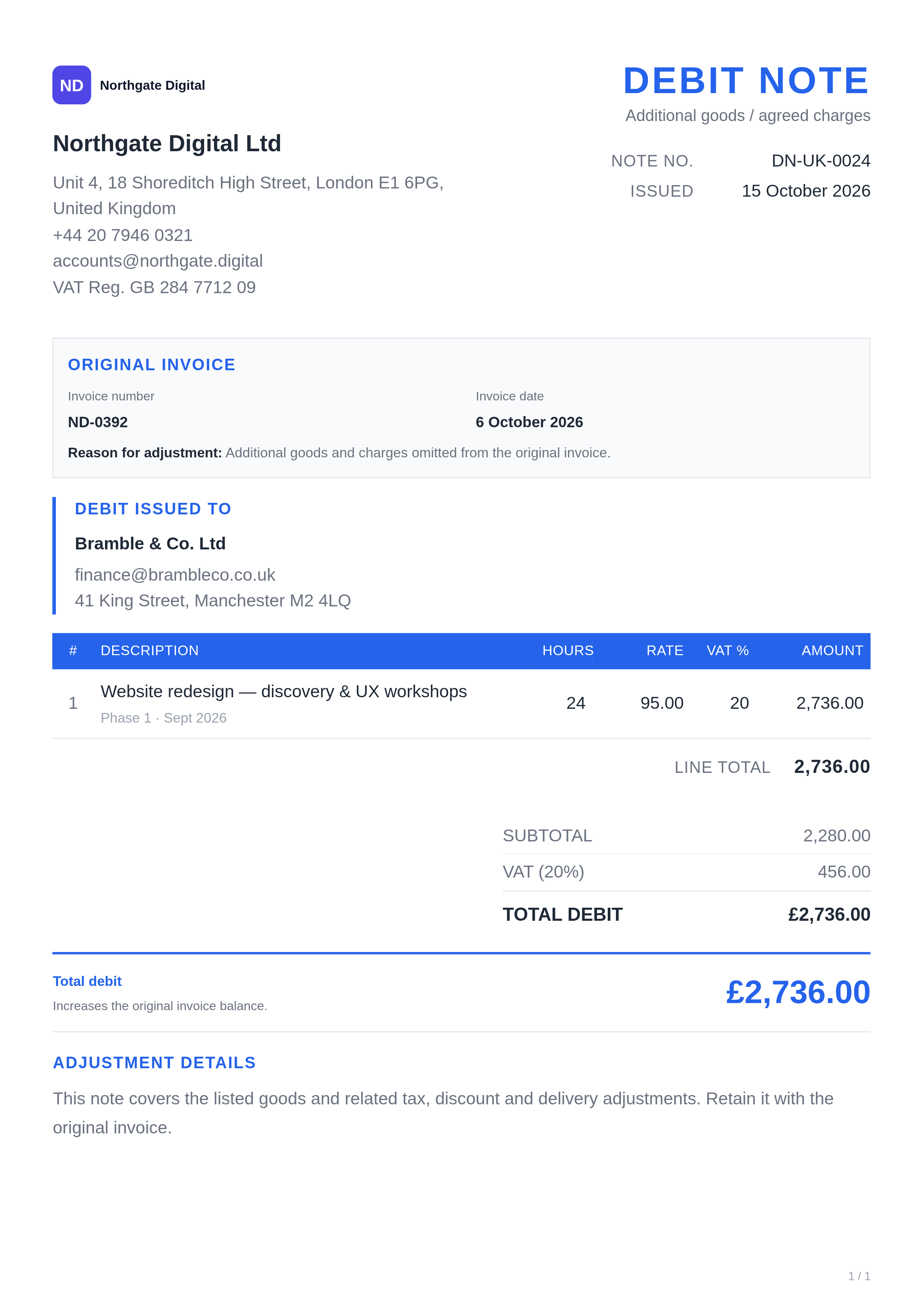
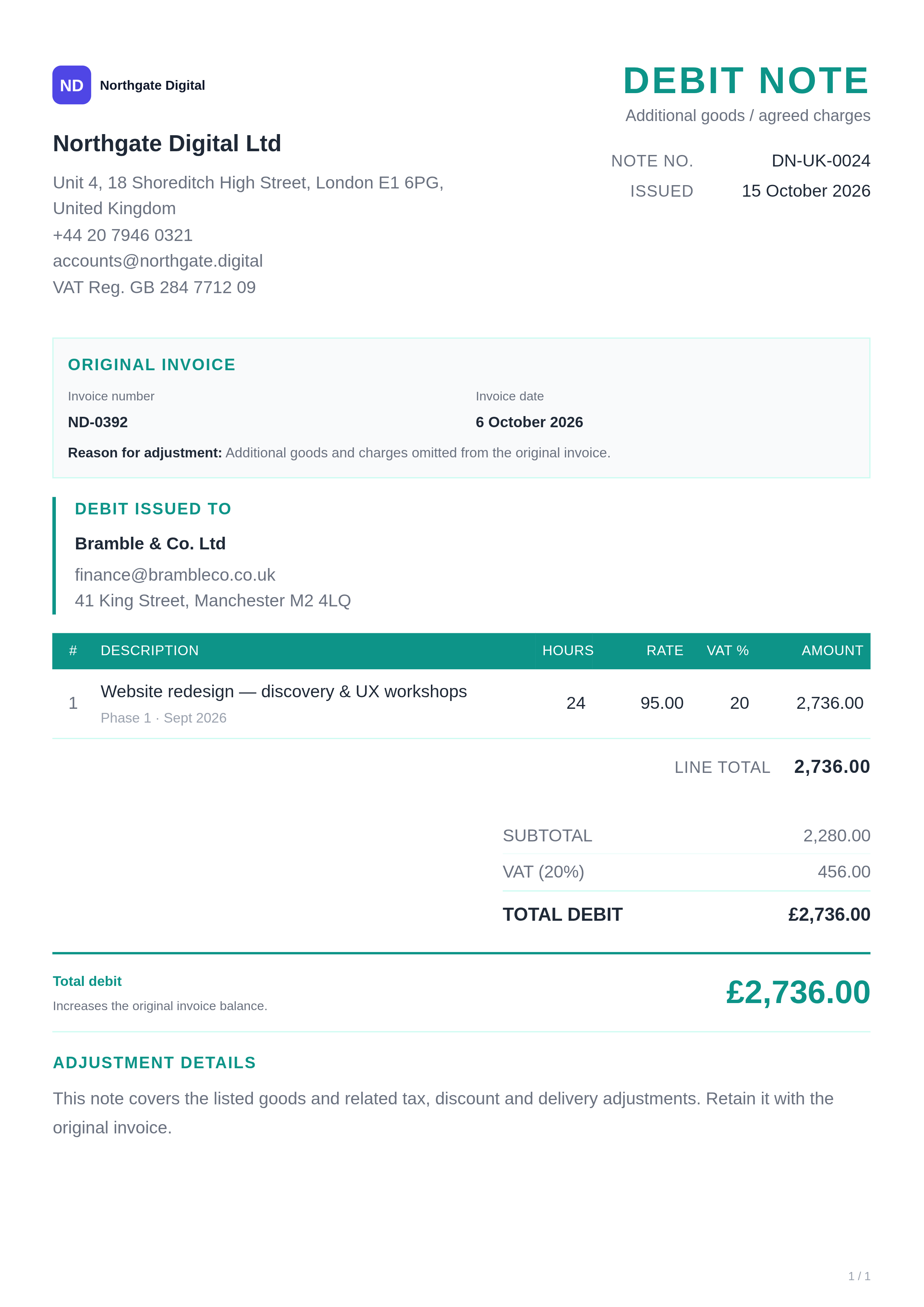
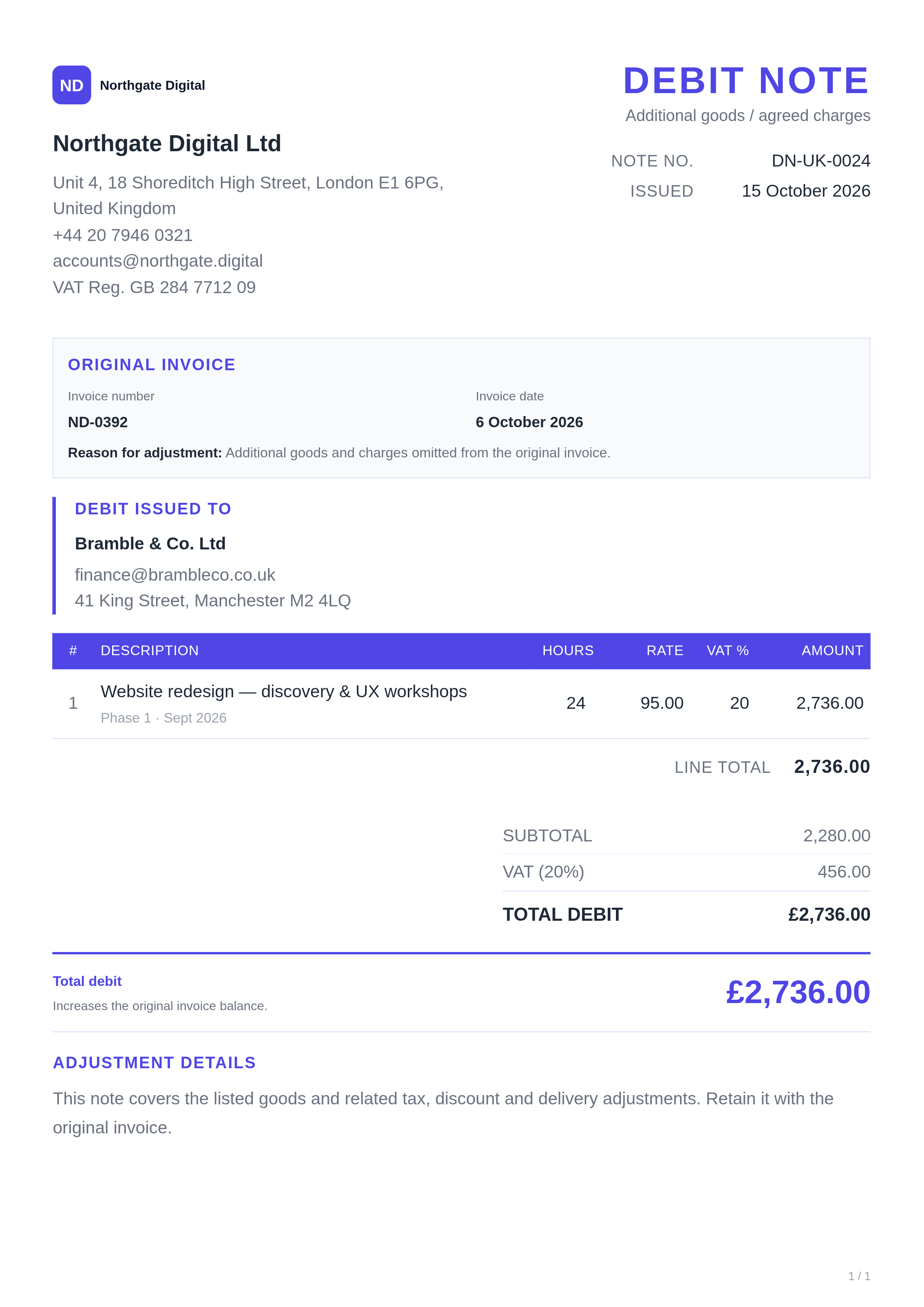
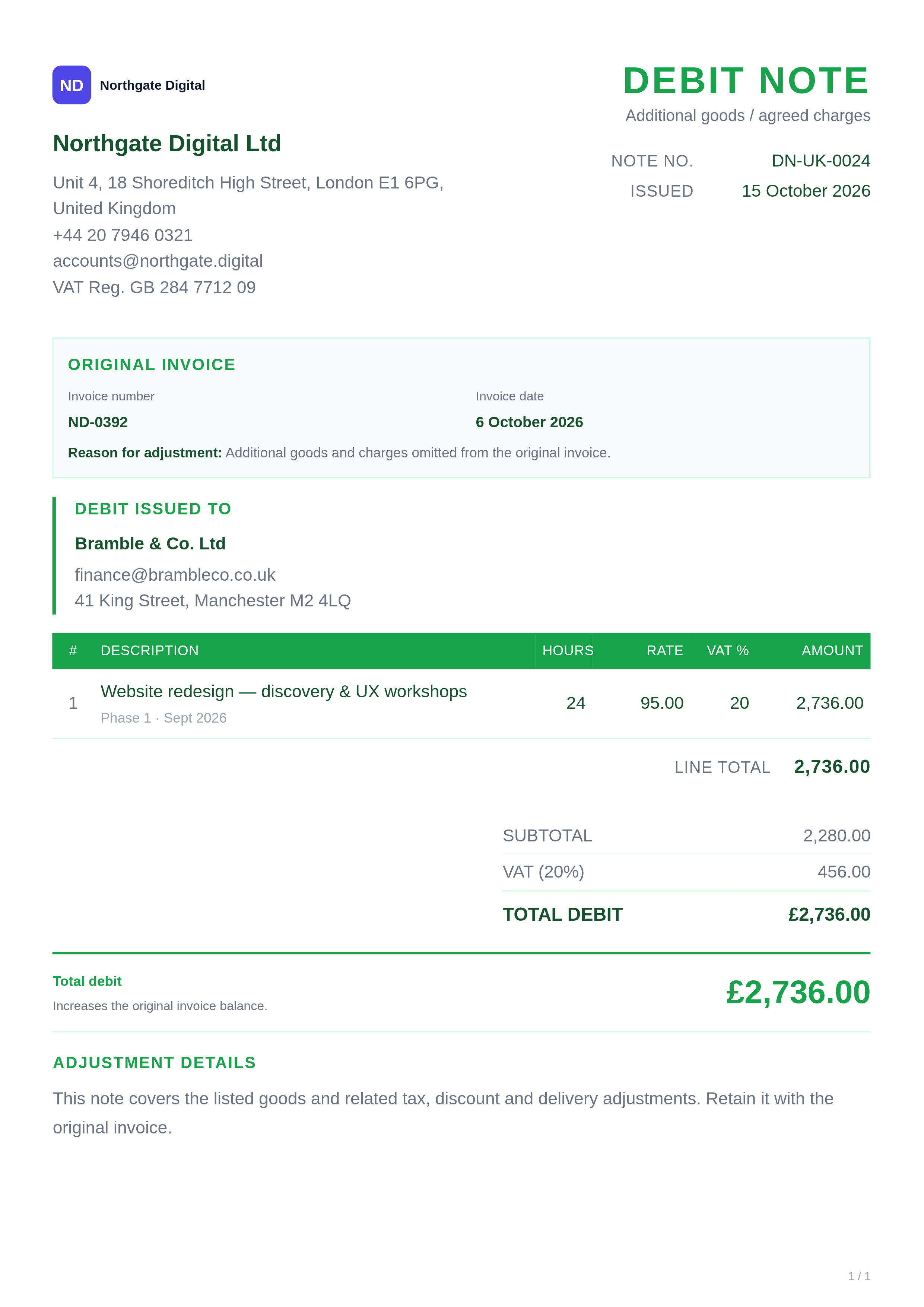
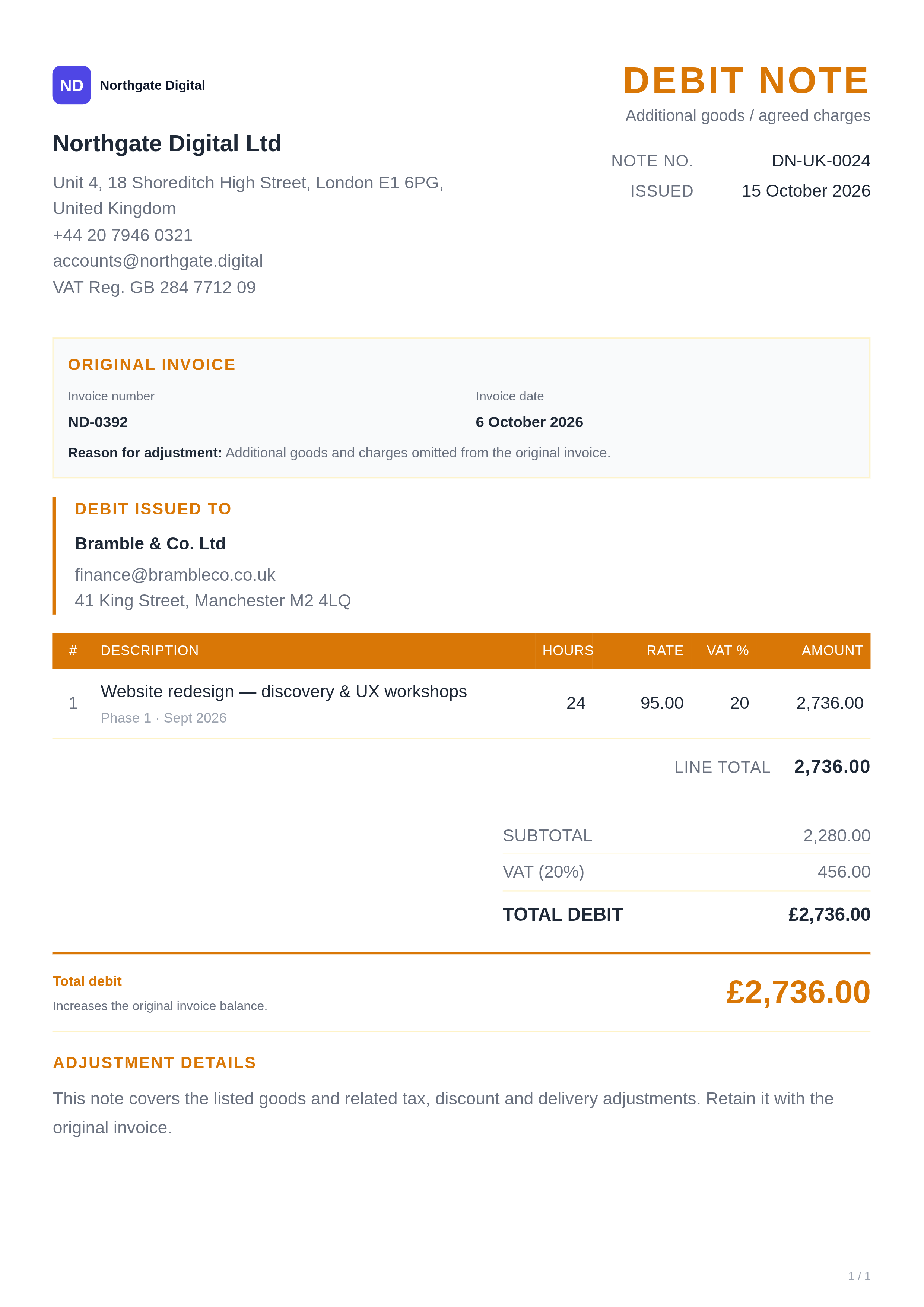
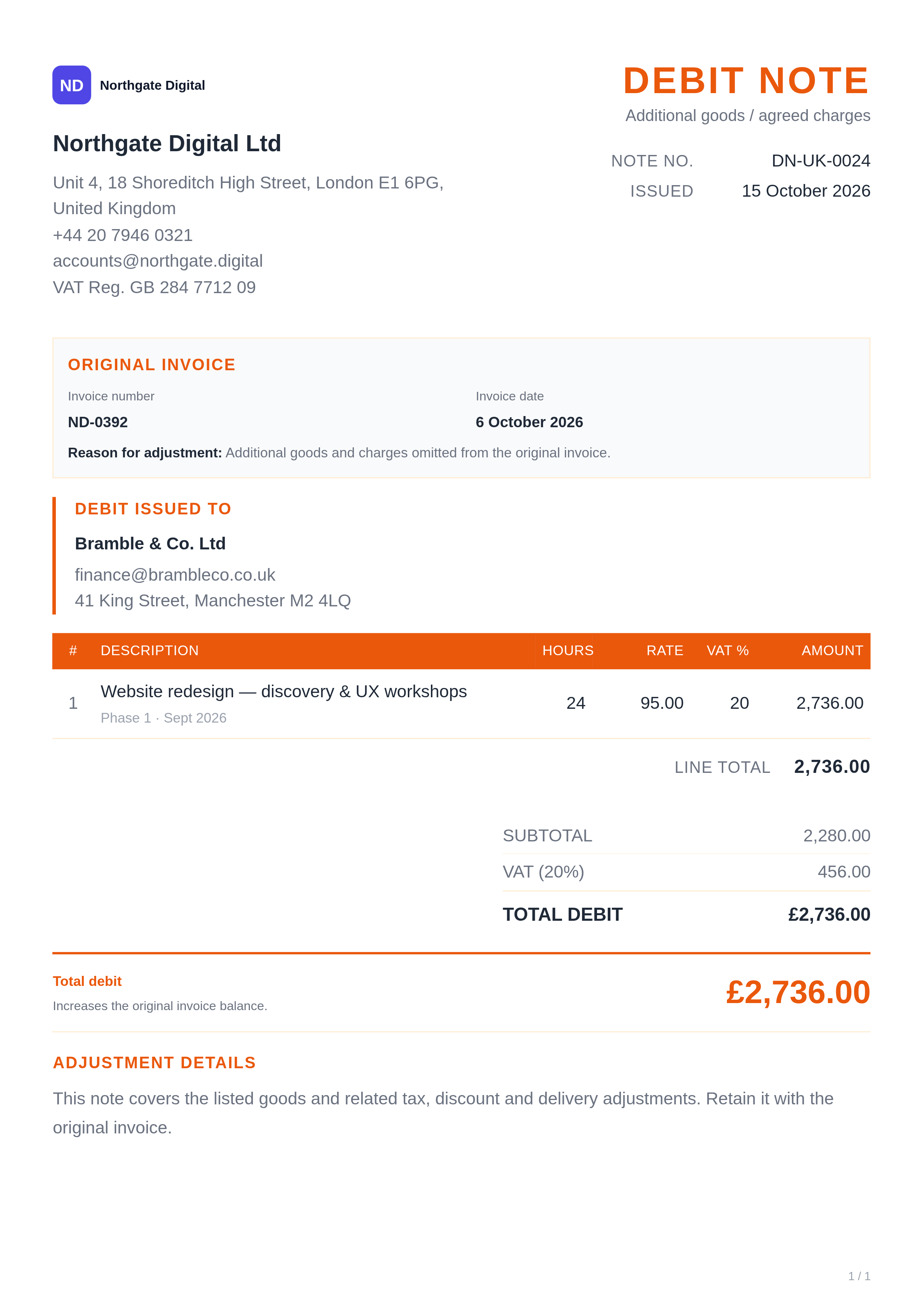
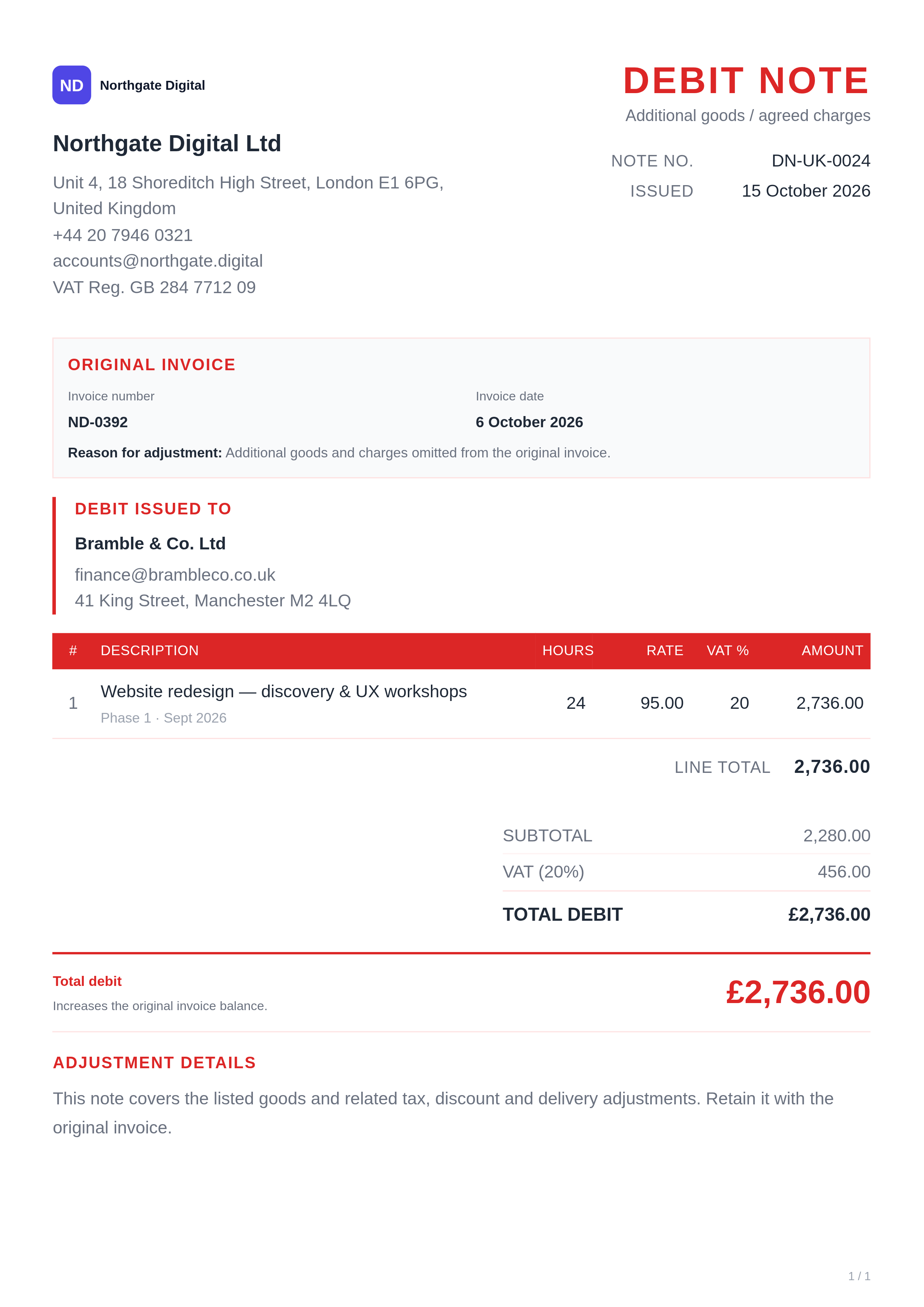
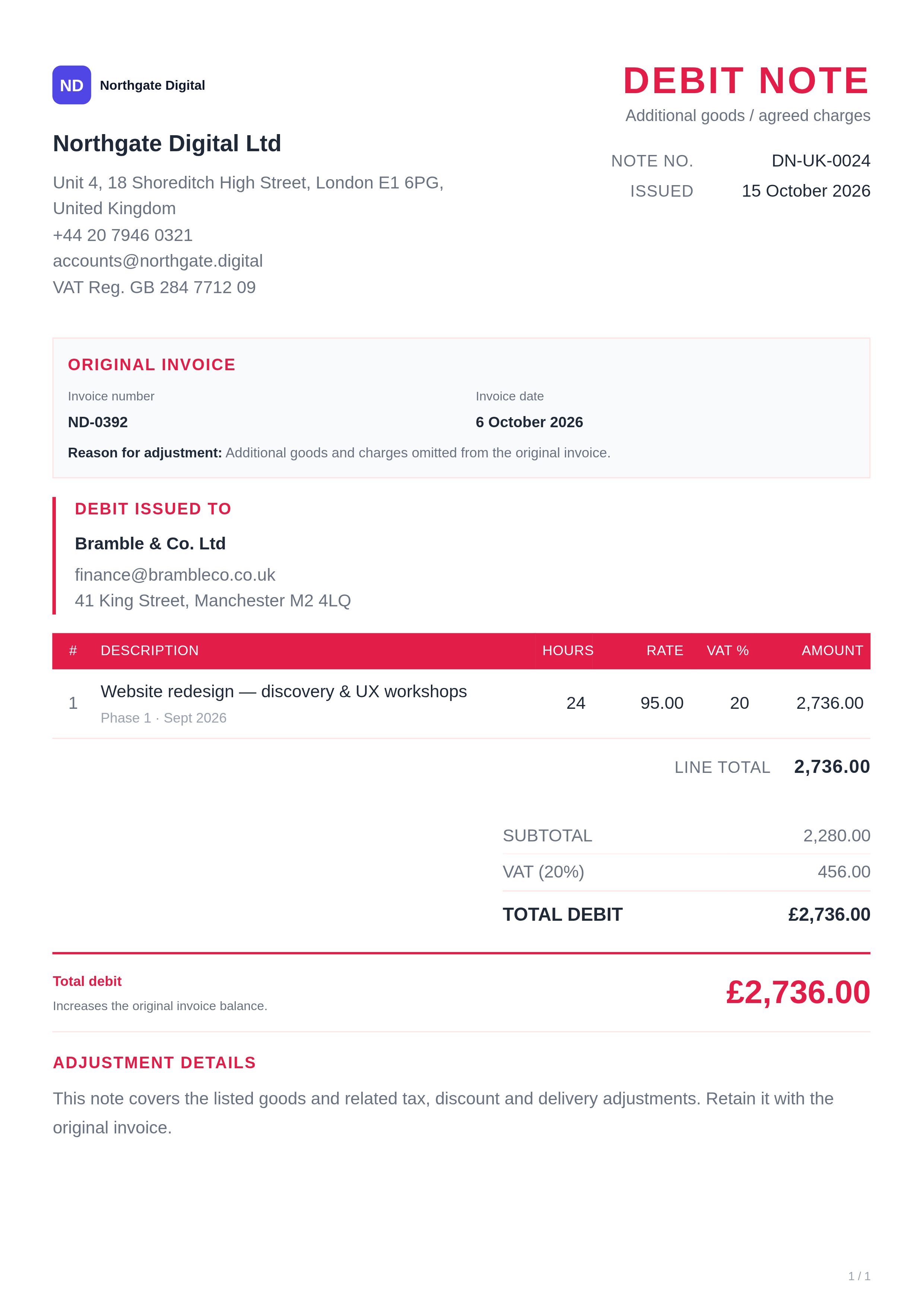
An illustrative £1,200 invoice has £400 already paid. A £240 seller debit leaves £1,040 to collect. The debit increases the bill; it does not record another payment.
| Original invoice | Payment | Debit | Remaining |
|---|---|---|---|
| £1,200 | − £400 | + £240 | £1,040 |
A seller-issued debit note documents an increase to an earlier invoice, such as an undercharge or agreed additional charge. A buyer-issued debit memo can instead request supplier credit for a shortage or return. Identify the issuer and purpose before posting it.
A seller-issued debit note adds to the customer charge. A buyer-issued claim may request a reduction of the buyer’s payable, subject to supplier agreement. The document title alone does not establish its effect.
No. It records an adjustment or claim, not a transfer of money. Keep payments and their dates, amounts and references separately linked to the account.
The ten supplied downloads are static UK-style PNG previews with sample details. The separate free generator lets you enter your own details and print or save a PDF using its own GST layout.
Creating a note does not itself establish that a charge is owed. Verify the order, contract, supply evidence and any necessary acceptance before treating it as collectible.
No. A correction for goods already delivered changes billing without another dispatch. A buyer return needs a separate goods movement and supplier reconciliation.
No. A bank debit is money leaving an account. A commercial debit note documents an invoice adjustment or supplier claim.
A valid seller debit creates an additional amount to collect. Retain the original payment allocation and track payment against the new charge without reopening already settled amounts.
The previews use UK-style GBP and VAT details. HMRC sources cover UK invoice adjustments. The GST guide references India’s CGST Act section 34. Commercial buyer claims and supplier tax documents have different roles. Source links checked on 17 October 2026.
Enter your own details in the free debit note generator. It offers GST fields and browser print or PDF output in its own layout. Review the tax fields for your transaction.
Create a debit note